People ask me all the time, “So… what do you actually do for a living?”
This is my best attempt at explaining it, especially with how fast search is changing – from classic SEO (Search Engine Optimization) to GEO (Generative Engine Optimization) and AIO (AI Overviews).
Once upon a time, “doing SEO” meant sprinkling keywords around, begging for backlinks, and praying to the Algorithm Gods for page-one rankings. Cute era. Very retro.
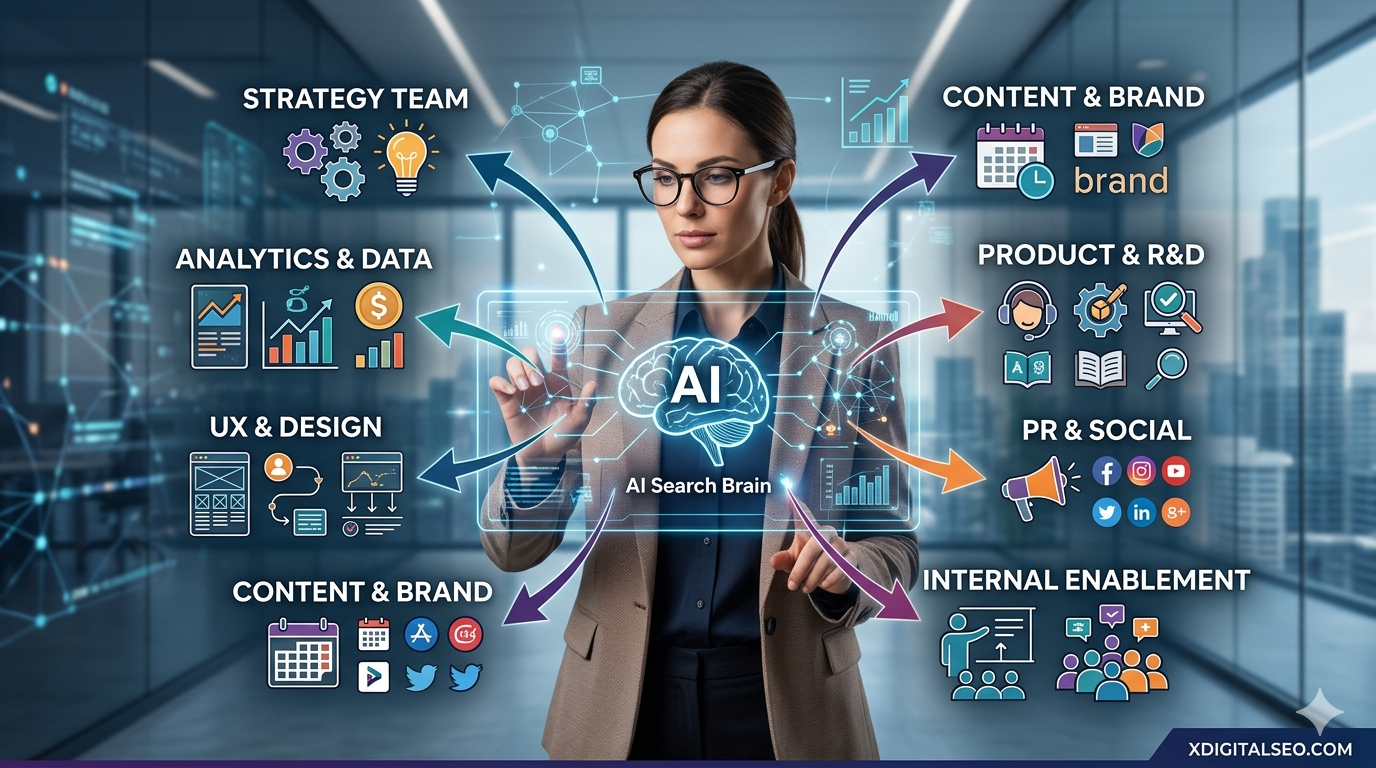
Today, a modern SEO + AI Search Strategist is less “meta tags gremlin” and more “central intelligence layer” for your business – feeding strategy, content, product, PR, support, and even internal training with live demand signals from how real humans search and how AI engines answer. Rankings are just the side effect. The real value is everything that happens around them.
1. Not just rankings: building your “search brain.”
Your website is not supposed to be a digital brochure. It can be a search-powered insight engine – if someone is actually treating it that way.
A proper SEO + AI search program gives you:
- A living map of what people are asking, in their own language, across Google and AI assistants.
- Clean technical foundations so those answers load fast, make sense, and are easy for both humans and machines to navigate.
- Tagging and measurement that tie keywords, intents, journeys, and conversions together, instead of random “traffic went up 🤷♀️” reports.
That same “search brain” is then plugged into… well, everyone.
2. Strategy team: less guessing, more “here’s the evidence.”
Your strategy team doesn’t need another brainstorm. They need proof.
SEO and AI search data show:
- What people are actually asking in your category right now.
- How demand breaks down by topic, problem, geography, and segment.
- Which messages get ignored and which ones people lean into?
A modern SEO turns that into opportunity maps, early-warning signals of emerging needs, and positioning input that keeps decks honest and investments pointed where demand already exists.
3. Analytics team: from “pageviews” to “this intent prints money.”
Analytics teams secretly love a good SEO.
Because when search work is done properly, it forces:
- Clean event tracking and consistent goals across key journeys.
- Data that connects intent → landing page → behavior → revenue.
- New AI-era KPIs like brand citation rate inside AI answers and share of voice in overviews, not just “organic sessions.”
Translation: instead of staring at dashboards wondering what it all means, you can answer “which search intents actually make us money, and which ones waste everyone’s time?”
4. UX & design: less arguing over menus, more designing for how people think
Your users don’t care about your org chart. They care about finding the thing they came for without wanting to throw their laptop.
Search and on-site behavior reveal:
- The actual words people use when they’re trying to do something.
- Where they get stuck, bounce, or rage-click their way out.
- Which flows quietly works because they match how people naturally search and decide.
A modern SEO/AI strategist turns that into information architecture, navigation labels, page templates, and content patterns that feel intuitive because they’re built from real query and behavior data, not vibes in a design review.
5. Content & brand: a never-ending, data-backed content backlog
If your content calendar is still “what do we feel like posting this month?”, that’s a red flag.
Search and AI insight can give your content and brand teams:
- A prioritized backlog of real questions, objections, and comparisons your audience is already typing (and speaking) into search boxes and chatbots.
- Guidance on tone, depth, and structure that performs for both humans and algorithms.
- Semantic structures and entities that steadily build topic authority, not just “another blog post.”
Over time, this is how you “own” a problem space in both traditional search and AI-generated answers – your brand becomes the default recommendation when people ask those questions.
6. Product & R&D: always-on market research you forgot you had
Spoiler: your customers are literally telling you what features they want in search bars.
When you listen, you’ll see:
- Repeated pain points bundled with your brand, competitors, and specific use cases.
- Gaps and “wish this existed” searches that point directly at product opportunities.
- Language shifts and category evolution over time, so you can adjust the roadmap and messaging before your competitors clock it.
A modern SEO/AI strategist packages this into insight packs, landing-page experiments, and visibility checks that de-risk product bets long before you throw serious budget at them.
7. Customer support: fewer tickets, faster answers, happier humans
Your help center is secretly one of your highest-value SEO assets.
With the right support from SEO + AI search, you can:
- Turn common tickets into findable, optimized self-service content that actually shows up when people search for it.
- Align help articles with the exact phrases customers use when they’re frustrated and trying to fix something.
- Surface recurring pain points back to product, UX, and content, so the root problems get solved, not just handled.
Result: fewer “where do I find…” questions, more “wow, that was easy.” And yes, that also feeds back into better organic performance and AI visibility.
8. PR & social: turning buzz into durable search and AI equity
PR isn’t just about that one big spike in traffic anymore.
With an SEO/AI strategist in the mix, PR and social can:
- Make sure thought leadership, press, and executive profiles are structured so search engines and AI models treat them as authoritative sources.
- Align narratives, entities, and links so earned coverage compounds into long-term authority and more frequent mentions in AI answers.
- Use search trends and emerging topics to feed social calendars, so you’re posting into demand instead of just posting into the void.
That’s how a good launch turns into ongoing discoverability and recommendation, not a one-and-done spike.
9. Internal enablement: everyone speaking the same “customer.”
Here’s the underrated bit: SEO and AI search insight is incredible fuel for internal training.
A central SEO/AI function can:
- Turn live search and conversation data into regular internal briefings and onboarding materials.
- Align teams on the same customer language, category definitions, and signals of intent.
- Create a culture where decisions are grounded in real-time demand, not last year’s slide deck.
Suddenly, sales, marketing, product, and support are all talking about the same customer reality – because they’re looking at the same evidence.
10. So… what does XDigitalSEO actually do in all of this?
At XDigitalSEO, we treat SEO and AI search as your business’s evidence engine – not a ranking hack.
That looks like:
- Building the technical and content foundations so your site is fast, understandable, and discoverable across traditional and AI-driven search.
- Setting up the “search brain” – research, tagging, measurement, and AI-era KPIs – that every team can plug into.
- Working with strategy, analytics, UX, content, product, PR, social, and training teams to ensure everyone gets the inputs they need from a single, centralized source of truth.
Rankings are the receipt. The real value is better decisions, better experiences, and a brand that keeps showing up – in Google, in AI overviews, and in the heads of your ideal customers.
If you’re still hiring “SEO” just to chase blue links, you’re under-buying what search and AI can do for your business.
Contact XDigitalSEO
You can also find us on: